LAW
Long before the United States existed, Indigenous Nations had their own systems of governance rooted in responsibility, diplomacy, and relationships to land and community. The Haudenosaunee Confederacy brought multiple Nations together through councils guided by the Great Law of Peace. Many Southeastern Tribal Nations followed matrilineal clan systems, where Clan Mothers played an important role in selecting and advising leaders. Among the Muscogee, Mekkos were the town leaders, and guided the political and ceremonial life of their Tribal towns. These systems show that Indigenous governance was firmly established long before the establishment of the United States and continues to shape Native political life today.
Indigenous Governance before the United States

Women's Voices at the Council by Joan Hill
Courtesy of the Oklahoma Arts Council
EXPLORE INDIGENOUS GOVERNANCE
Among many Southeastern Indigenous Nations, matrilineal systems have long shaped political, social, and community life. Clan identity and kinship are carried through the mother’s line, connecting individuals to extended networks of family, responsibility, and belonging. Women have historically held important roles in maintaining these relationships, guiding community life, influencing leadership, and carrying knowledge across generations. These structures demonstrate that Indigenous governance extends beyond formal political institutions and is rooted in kinship, collective responsibility, and relationships between generations.
Clan Mothers & the Great Law of Peace
Among the Haudenosaunee, Clan Mothers hold significant political authority within the traditional system of governance. They select and advise the male leaders who represent their clans on the Haudenosaunee Confederacy Council and have the authority to remove a leader who fails to fulfill his responsibilities to the people. Their role reflects a system in which political leadership is rooted in matrilineal kinship, accountability, and responsibility to both present and future generations.
Foundations of Federal Indian Law
.png)
Doctrine of Discovery
Issued in 1493, the Doctrine of Discovery stated that Christian European nations could claim lands already inhabited by Indigenous Peoples. Based on religious ideology, it became a legal and moral justification for colonization and the taking of Indigenous lands and resouces.
Hiawatha & Covenant Belts
Long before the United States, Indigenous Nations had sophisticated systems of governance, diplomacy, and alliance. Wampum belts recorded agreements, responsiblities, and relationships between sovereign Nations.
The Haudenosaunee Confederacy and its Great Law of Peace have long been known for their influence on the U.S. Constitution.

.png)
The Marshall Trilogy 1823-1832
The Marshall Trilogy-Johnson v. M’Intosh (1823), Cherokee Nation v. Georgia (1831), and Worcester v. Georgia (1832),established the legal framework for federal Tribal law. Although the decisions limited and challenged Tribal sovereignty, they also acknowledged that Tribal Nations retain inherent rights of self-government. Tribal sovereignty did not end with these cases. Tribal Nations continue to be sovereign Nations today, despite the challenges of these cases.
TREATIES
From the earliest years of the United States, Tribal Nations entered into treaties as independent governments. These agreements established peace, defined boundaries, recognized rights, and outlined responsibilities between Tribal Nations and the United States. Under the U.S. Constitution, treaties are recognized as the "supreme Law of the Land." Although many treaty promises were broken or ignored, treaties remain legally binding agreements that continue to shape Tribal sovereignty today.
Treaty of Cusseta, 1832
In the Treaty of Cusseta, the Muscogee (Creek) Nation ceded its remaining homelands in present day Alabama. In exchange, the United States recognized Muscogee lands in Indian Territory and promised them “forever.” Yet this promise was repeatedly broken. The opening of Indian Territory to non-Native settlement, the Oklahoma Land Runs, and federal allotment policies diminished Tribal lands and challenged Muscogee sovereignty.
.png)

McGirt v. Oklahoma
In 2020, the U.S. Supreme Court reaffirmed that the Muscogee Reservation had never been disestablished by Congress and remains Indian Country under federal law. The decision affirmed a fundamental principle of Tribal sovereignty: promises made through treaties remain legally binding unless Congress clearly says otherwise.
Tribal sovereignty is exercised through jurisdiction, the authority to govern people, lands, resources, and relationships. Tribal Nations exercise this authority through their own governments, courts, law enforcement, and agreements with other governments.
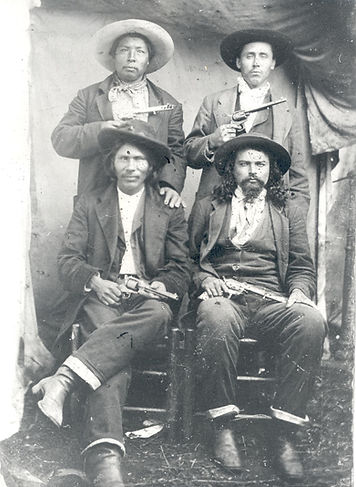
Jurisdiction is Sovereignty in Practice
Choctaw Lighthorsemen, 1928. Courtesy of the Oklahoma Historical Society, Otis Leader Collection
INDIAN CHILD WELFARE ACT (ICWA)
Before the Indian Child Welfare Act (ICWA) was passed in 1978, Native children were regularly separated from their families through federal policies and state child welfare systems. During the 1920s, approximately 83 percent of Native children attended government or church-run boarding schools, where many were prohibited from speaking their languages or practicing their cultural traditions. By the 1970s, an estimated 25 to 35 percent of Native children had been removed from their families through adoption, foster care, or institutional placement, often without the involvement or consent of their Tribal Nations.
ICWA was enacted to help end these practices by recognizing Tribal Nations’ authority in child welfare decisions involving their citizens. The law acknowledges that Native children are not only members of families, but also citizens of sovereign Tribal Nations with political and cultural ties that deserve protection. Although ICWA has helped reduce unnecessary removals, Native children continue to be disproportionately represented in the child welfare system, and Tribal Nations continue to advocate for the protection of their children, families, and communities.
EXPLORE THE HISTORY
Native American Boarding Schools
For more than a century, the U.S. government supported the removal of Native children from their families and Nations into boarding schools designed to assimilate them. Despite these policies, Native families and communities protected and carried forward their languages, cultures, and relationships.
Drawing from oral histories, photographs, letters, and archival records, this graphic novel tells the story of Chilocco Indian Agricultural School through the experiences of Native families across generations. By centering Indigenous voices and lived experiences, it explores the lasting impacts of the federal boarding school system while celebrating the resilience of Native communities.
LEARN MORE: Native Children & Foster Care
Native children continue to be disproportionately represented in foster care across the United States. ICWA helps protect Native children, families, and Tribal Nations by keeping decisions about Native children connected to their families, communities, and Tribes.
Learn more about ICWA, Tribal jurisdiction, and the protections established for Native children, families, and Nations
Read the Supreme Court decision.
In 2023, the U.S. Supreme Court upheld the Indian Child Welfare Act in Haaland v. Brackeen, rejecting constitutional challenges to the law and preserving important protections for Native children, families, and Tribal Nations.
Season 2 of This Land explores the legal battle over the Indian Child Welfare Act and how challenges to protections for Native children became a broader challenge to Tribal sovereignty.
NAGPRA & REPATRIATION
The Native American Graves Protection and Repatriation Act (NAGPRA), passed in 1990, recognizes the rights of Tribal Nations to reclaim their ancestors, funerary objects, sacred items, and objects of cultural patrimony from museums, universities, and federal agencies. More than a repatriation law, NAGPRA acknowledges the enduring relationships Indigenous Nations have with their ancestors, sacred places, and cultural heritage. For many Tribal Nations, protecting ancestors is both a cultural responsibility and an expression of sovereignty.
.jpg)
Why NAGPRA?
Native ancestors and cultural belongings remain in museums, universities, and other institutions, many after being removed from burial places and communities without Tribal consent. NAGPRA provides a legal process for the return of ancestors and certain cultural items, but repatriation continues to be a long and ongoing process for many Tribal Nations and Native communities. Tribal Nations continue to battle the desecration of ancestral burial sites.
Photograph of Temple Mound at Spiro Mounds, in Spiro, OK, showing the ragged destruction by the "pot-hunters" who located the site for commercial purposes, c. 1936.
Courtesy of the Oklahoma Historical Society
EXPLORE MORE

This letter from the U.S. Senate Committee on Indian Affairs calls on the University of California to comply with NAGPRA and expedite the return of Native American ancestors and cultural belongings. It reminds institutions that repatriation is not only a legal obligation, but an act of justice and respect for Tribal Nations.
NAGPRA Compliance Letter
Justice for Hickory Ground
Hickory Ground (Oce Vpofv) is an ancestral Mvskoke tribal town ground in present-day Alabama. For generations, it served as a place of ceremony, governance, and burial for the people. Following the forced removal in the 1830s, the site remained a sacred connection.
In the early 2010s, construction and excavation disturbed the Ancestors' resting places. These actions prompted Hickory Ground, the Muscogee (Creek) Nation, and supporters to advocate for the protection of the site and the respectful treatment of ancestral remains. The Justice for Hickory Ground movement continues this effort today.
The movement emphasizes that sacred sites are living places of cultural, historical, and spiritual significance. It also affirms that tribal sovereignty includes the responsibility to protect ancestral homelands and honor those who came before us.
Please visit JusticeforHickoryGround.com
.jpg)
Photograph, c. 2024
Photograph by Shane Brown. Courtesy of Sterlin Harjo